
Standards & Certifications
ULC Certified
CAN/ULC S1001
CSA Z320
CSA Z8001
CSA Z317.2
CSA Z5000 / Z5001 for energy consuming systems
Commissioning management
Commissioning provider
Commissioning agent
LEED Cx Authority
LEED AP BD+C
ACP: BCxA
BCxA Member
AScT: ASTTBC
EIT, P.Eng (EGBC)
BC Hydro COP
How We Commission Differently
Commissioning with us isn’t a stack of paperwork and a checklist at the end of the project. We get involved early: helping set commissioning priorities, sequencing tasks, supporting readiness planning, tracking deficiencies, and coordinating the work that carries systems from installation through functional testing and closeout.
In practice, that means schedule input, test readiness reviews, issue tracking, and coordination with contractors and consultants, plus regular review of upcoming Cx tasks. We prioritize whatever could affect turnover, occupancy, life safety, system performance, or how the owner ultimately operates the building.
We keep contractor quality control and independent commissioning verification separate. Contractors stay responsible for their own installation checks, startup, and deficiency correction. Our job is the objective review on behalf of the owner and project team: verifying required prefunctional checks, completing functional testing, reviewing system sequences, documenting deficiencies clearly, and confirming issues actually get resolved.
We bring TAB, controls, mechanical, electrical, IMIT, and integrated systems testing experience into the commissioning process, so we’re not just working through a checklist. We’re looking at how the building actually operates: airflow, hydronic flow, pressure relationships, control response, equipment operation, and life safety integrations, all reviewed together so the owner gets a clearer picture of real building performance.
Every project’s different, so the work is scoped to match. We support owners, consultants, contractors, and facility teams with hands-on field verification, practical coordination, clear issue tracking, and reliable closeout documentation.
What Is Commissioning
Commissioning That Verifies Real Building Performance Before Handover
Techical Definition
Building commissioning is the process of verifying that a facility’s mechanical, electrical, plumbing, controls, and integrated systems are designed, installed, tested, and capable of operating in accordance with the Owner’s Project Requirements.
At handover, contractors confirm their systems are complete. Commissioning goes further: it’s independent verification that those systems are actually operating as intended, before the owner accepts responsibility for them.
Without commissioning, owners can inherit systems with installation deficiencies, untested control sequences, incomplete integration, and equipment that looks compliant on paper but underperforms in operation. Catch these during construction and they’re usually faster, easier, and cheaper to fix.
For healthcare facilities, LEED projects, and complex institutional buildings, commissioning is often required by project specifications, owner standards, building code pathways, CSA standards, and certification programs. ITSL provides the independent oversight needed to meet those requirements and protect the owner’s long-term operational interests.
ITSL’s approach goes beyond a checklist. Our providers are in the field, observing systems under real operating conditions, testing control sequences, reviewing design documentation, and tracking issues. We work directly with owners, consultants, and contractors to resolve problems before turnover.
Standards We Work To
CSA Z320: Building Commissioning
Core Canadian standard for commissioning of new and existing buildings. Governs our Commissioning Plans, Field Reports, and Cx Manuals.
CSA Z8001: Commissioning of Healthcare Facilities
Healthcare-specific commissioning standard. Required for all BC acute care and long-term care facilities.
ASHRAE Guideline 0 & 1.1
International framework for commissioning process and HVAC systems. Foundation of LEED fundamental and enhanced commissioning.
LEED Fundamental & Enhanced Cx
CaGBC requirements for LEED certification. ITSL serves as Commissioning Authority on LEED projects across Interior BC.
BCxA Best Practices
ITSL’s owner, Luke Buis, sits on the board of directors for the BCxA Western Canadian Chapter and is the 2025 chapter past president. Our processes align with and contribute to BCxA protocols.
CSA Z5000 / Z5001 (Development)
National standards for energy-using systems currently in development. ITSL contributes directly to their authorship.
Our Process
Commissioning From Design Through Handover
Effective commissioning starts before construction and continues until systems are tested, documented, and ready for operation. ITSL provides continuity through each phase, connecting design review, field verification, functional testing, issue tracking, and owner training into one coordinated process.
Real-Time Tracking via Bluerithm: Every deficiency, checklist, and test result is tracked in Bluerithm’s cloud-based commissioning platform. Owners, consultants, and contractors get live access to project status, the issues log, and test records throughout the commissioning process. No waiting for monthly reports to find out where a project stands.
01. Design Review and Commissioning Planning
ITSL reviews the Owner’s Project Requirements, Basis of Design, drawings, specifications, and commissioning scope to identify gaps early. This helps the project team address unclear requirements, coordination issues, access concerns, and testing expectations before they become field problems.
02. Construction Observation and Prefunctional Checks
During construction, ITSL performs prefunctional checks in the field to verify that equipment is installed, started, communicating, and ready for testing. Many commissioning providers rely on installing contractors to complete these checks on their behalf. That can create gaps: issues get missed, checklists get treated as paperwork, and deficiencies don’t turn up until functional testing begins.
ITSL’s approach gives the owner a more reliable view of equipment readiness before sequence verification starts. Our team confirms equipment condition directly, documents findings, and identifies issues early enough for the project team to correct them before closeout pressure builds.
03. Functional Performance Testing and Issue Tracking
Functional Performance Testing is completed in two stages. First, equipment operation is verified. Then, once equipment is ready, ITSL tests the control sequences, operating modes, safeties, alarms, interlocks, and system integration.
Job progress, test status, deficiencies, and open issues are tracked through cloud-based software so the project team can review progress in real time. Issues can be assigned to responsible parties, updated as work is completed, and carried through to resolution.
04. Reporting, Manual, Training and Handover
ITSL provides the final commissioning report, issues log, commissioning documentation, and Cx Manual. We also support owner and operator training, so the facilities team understands how the systems are meant to operate, be maintained, and be verified after turnover. Handover comes out cleaner, with fewer unresolved issues and better building performance over the long term.
Recommissioning Process
Existing Building Commissioning That Starts in the Field
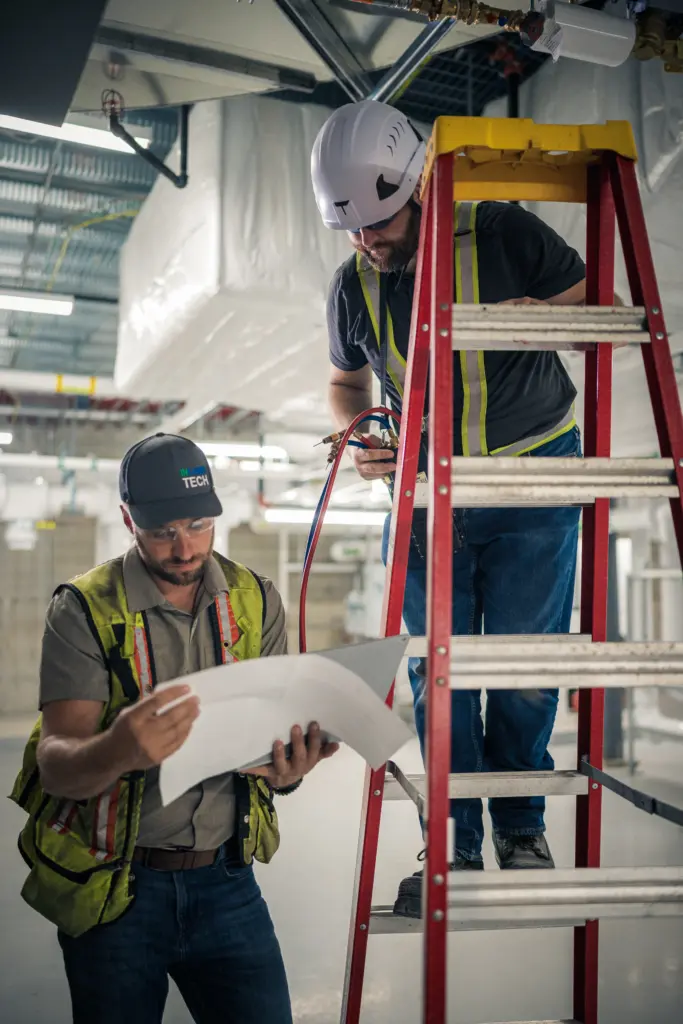
Recommissioning is used to improve how existing buildings operate without jumping straight to major capital upgrades. ITSL’s process starts by understanding the owner’s current requirements, reviewing available documentation, and verifying how the building is actually performing in the field.
01 Planning and Building Review
ITSL reviews available drawings, O&M information, BAS graphics, past reports, energy data, and owner concerns to understand the building, its history, and known operating issues.
02 TAB Survey and Field Investigation
ITSL recommends a TAB survey at the beginning of every recommissioning project. We treat this as a functional test of the distribution systems, confirming how air and water are actually moving through the building before recommendations are made. This helps separate balancing issues from control issues, equipment issues, or design limitations.
03 Controls and Sequence Review
ITSL reviews BAS operation, schedules, setpoints, alarms, trend logs, and control sequences to confirm whether systems are operating as intended. Field testing is used to verify actual operation, not just what appears on the BAS screen.
04 Issues Log and Recommendations
Findings are documented in an issues log with practical recommendations for correction. The focus is on low-cost and no-cost improvements first, including balancing corrections, control adjustments, scheduling changes, sensor issues, and operational improvements.
05 Implementation and Verification
Once corrective actions are approved, ITSL can support implementation review, retesting, and verification. This confirms that the recommended changes were completed and that the building is operating closer to the owner’s current requirements.
06 Ongoing Commissioning Support
ITSL can also support ongoing commissioning through periodic reviews, trend log analysis, functional retesting, and updated documentation to help maintain building performance over time.
Commissioning Services
What ITSL Delivers on a Commissioning Engagement
Our commissioning scope adapts to each project type, from new hospital towers to existing facility retrofits.
New Building Commissioning
Full commissioning scope for new construction: design review through functional testing and handover documentation. Aligned with CSA Z320, ASHRAE Guideline 0, and LEED requirements. ITSL serves as the independent Commissioning Authority, with no conflicts with the installing contractors.
CSA Z320
ASHRAE Guideline 0
LEED Cx Authority
Healthcare Commissioning
Specialist commissioning for BC acute care hospitals, long term care facilities, and medical office buildings. ITSL has delivered commissioning services across many major healthcare projects, including full hospital towers, clinical care buildings, and phased renovations in active care environments. Our team understands the coordination, documentation, infection control, procurement, and compliance expectations required for BC Health Authority projects.
CSA Z8001
CSA Z317.2
CAN/ULC S1001
LEED Commissioning
Commissioning Authority services for LEED Fundamental and Enhanced Commissioning requirements. ITSL manages the Owner’s Project Requirements, reviews contractor submittals, and delivers the commissioning report required for LEED certification submission, for both the CaGBC and international pathways.
LEED Fundamental
LEED Enhanced
CaGBC Aligned
Existing Building Commissioning
Retrocommissioning and recommissioning are both used to improve the performance of existing buildings. Retrocommissioning is typically used when a building has never gone through a formal commissioning process. Recommissioning applies the commissioning process again to a building that was previously commissioned, but may no longer operate as intended due to age, renovations, occupancy changes, control adjustments, or operational drift.
BC Hydro COP
Energy Optimization
Existing Buildings
Thermal Imaging
Renovation & Phased Cx
Commissioning of phased renovations and tenant improvements in occupied facilities, including hospitals, university buildings, and civic facilities. ITSL manages the sequencing complexity of commissioning active buildings where systems must remain operational throughout construction.
Occupied Facilities
Phased Delivery
Infection Control
Commissioning Management
For owners and project managers who need commissioning coordination across multiple disciplines, ITSL provides commissioning management services that integrate mechanical, electrical, controls, and life safety testing into a single, coordinated program. Includes stakeholder reporting and milestone management.
Multi-discipline
Bluerithm Tracking
Owner Reporting
Commissioning Services
Existing Building Commissioning
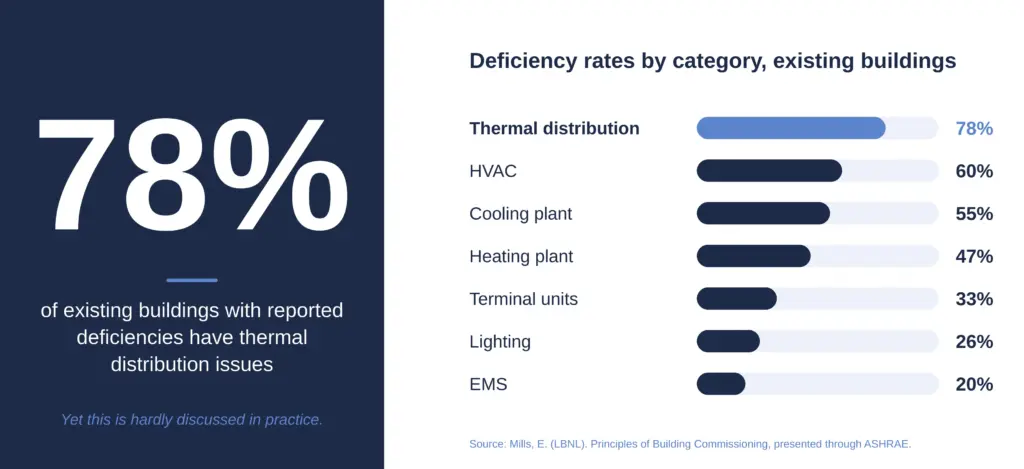
Our existing building commissioning process starts with understanding how the building is actually moving air and water. In many buildings, the biggest operational and energy problems aren’t found at the equipment nameplate. They’re found in the distribution systems, in airside and hydronic systems that are leaking, out of balance, improperly controlled, or no longer delivering flow where it’s needed. Lawrence Berkeley National Laboratory has shown that distribution system losses can be significant, including substantial fan energy increases from duct leakage and meaningful capacity losses from duct conduction. That’s why we put this much emphasis on field survey and verification of these systems.
Our work focuses on site investigation, distribution system survey, controls review, TAB assessment, and functional testing of existing systems. The goal: find where energy is being wasted and where building performance has drifted from intended operation. As a BC Hydro Continuous Optimization Program approved service provider, we bring that same performance-focused approach to existing buildings. Owners get a practical read on current conditions and a clear basis for low-cost corrective measures before anyone considers major capital upgrades.
10–30%
Typical savings from existing building commissioning (Berkeley Lab)
16%
Median whole-building savings (Berkeley Lab)
Commissioning Services
Ongoing and Monitoring-Based Commissioning
Commissioning shouldn’t end at turnover. Buildings change over time, as spaces get renovated, schedules shift, controls get adjusted, equipment ages, and operating priorities change. Ongoing commissioning helps owners maintain system performance after occupancy by periodically reviewing operation, catching drift, and confirming systems still meet current building needs.
Monitoring-based commissioning uses BAS trend data, utility data, alarms, schedules, setpoints, and equipment operation to flag performance issues that might not be obvious during daily operation. This can include simultaneous heating and cooling, excessive runtime, failed sensors, control sequence issues, unstable temperatures, ventilation concerns, and energy waste.
ITSL supports ongoing and monitoring-based commissioning through practical field review, trend analysis, functional retesting, TAB surveys, issue tracking, and operator support. The focus is on confirming how the building is actually operating and identifying low-cost improvements first. From there, we help facility teams maintain comfort, ventilation, energy performance, and reliable system operation over the life of the building.
Monitoring-based commissioning
Ongoing
Commissioning Services
Drone Thermal Imaging
Inland Technical Services provides drone-based thermal imaging to support building envelope reviews, HVAC system assessments, maintenance planning, and existing building performance investigations. Thermal imaging helps identify temperature patterns that are difficult to see from the ground or through visual inspection alone.
For building envelopes, drone thermal imaging can help spot potential heat loss, insulation gaps, thermal bridging, air leakage, moisture-related concerns, roof anomalies, and areas where the building envelope may not be performing as intended. This information can support facility planning, energy reviews, renovation planning, and further investigation by the owner or consultant team.
For mechanical equipment, thermal imaging can help review roof-mounted equipment, ducts, piping, coils, valves, heat exchangers, pumps, fans, and other HVAC components where abnormal temperature patterns may indicate performance issues. These reviews can flag potential heat loss, failed insulation, control issues, leaking valves, poor heat transfer, or equipment that may need further testing or maintenance.
Drone thermal imaging is especially useful for large buildings, rooftops, difficult-access areas, and existing facilities where safe and efficient site review matters. When combined with TAB experience, commissioning review, controls verification, and field measurements, thermal imaging adds another layer of information to help understand how a building is actually operating.
Thermal imaging results are documented with clear photos, location references, observations, and recommendations for follow-up review where required. The goal is practical information: something owners, consultants, and facility teams can use to catch issues earlier and prioritize corrective work, so comfort, reliability, maintainability, and energy performance all improve.
Drone
Thermal Imaging
Building envelope
Commissioning Services
Energy Optimization
Energy efficiency starts with building systems that are operating correctly. Inland Technical Services helps owners identify energy waste by reviewing actual HVAC system performance in the field, not just from utility data or control trends.
Our team combines testing, adjusting and balancing, commissioning review, controls verification, and measured field data to understand how air and hydronic systems are performing. That lets us catch issues like excessive airflow, incorrect outside air quantities, simultaneous heating and cooling, poor scheduling, failed dampers, leaking valves, inefficient fan or pump operation, and systems that no longer match the building’s actual needs.
Energy optimization reviews can include:
Fan and pump performance review
Airflow and hydronic flow assessment
Outside air and exhaust verification
Control sequence review
Setpoint and scheduling review
Energy loss identification
Thermal imaging
Mechanical system performance review
Recommendations for practical efficiency improvements
Our focus is on practical, achievable improvements that support comfort, reliability, maintainability, and reduced energy use. By understanding how the building is actually operating, Inland Technical helps owners prioritize corrective work, reduce unnecessary energy consumption, and improve long-term mechanical performance.
Healthcare Specialization
New Hospital Developments
ITSL has extensive experience supporting new hospital developments throughout BC and Western Canada. Our team has worked on major healthcare projects involving mechanical commissioning, testing, adjusting and balancing, integrated systems testing, controls verification, and closeout documentation.
On new hospital projects, system performance cannot be assumed from design documents or contractor sign-off alone. ITSL works directly in the field with the owner, consultants, contractors, and facility teams to verify that building systems operate as intended. Our role is confirming performance at the equipment, documenting deficiencies clearly, and supporting resolution before the building is turned over to operations.
From patient care areas and procedure spaces to mechanical rooms, life safety systems, and critical healthcare environments, ITSL brings practical site experience and a clear understanding of how hospital systems must perform once the building is occupied. Our commissioning process supports safe operation, reliable system performance, maintainable building systems, and efficient performance from day one.
Healthcare Commissioning Standards
CSA Z8001
CSA Z317.2
CSA Z315.2
CSA Z32
CSA C282
CAN/ULC S1001
BCxA Healthcare Protocol
Operating Healthcare Facilities
Existing hospitals require regular review to confirm that critical systems continue to operate safely, reliably, and efficiently. ITSL supports operating healthcare facilities with field-based testing, balancing reviews, recommissioning, and performance verification for mechanical, controls, and critical environment systems.
Our team evaluates isolation rooms, procedure rooms, operating rooms, pressure-controlled spaces, exhaust systems, ventilation systems, and other critical environment areas. Airflow, pressure relationships, temperature control, energy use, and system response all matter for patient and staff safety in these spaces.
In existing buildings, energy efficiency is often affected by control sequences, unoccupied operation, incorrect airflow, sensor issues, simultaneous heating and cooling, failed valves or dampers, and systems that have drifted from their original intent. ITSL combines TAB experience, commissioning review, controls verification, and field measurements to find where systems are wasting energy. At the same time, we confirm that healthcare performance requirements stay met.
These reviews help facility teams identify performance issues before they become larger operational problems. Where issues are found, ITSL provides practical troubleshooting, measured results, and clear documentation that supports corrective work, maintenance planning, energy improvements, and ongoing system reliability.
10+
Full hospital tower commissions across BC
2
Recent IST completions: Penticton Regional & Royal Inland
LEED Gold
Royal Inland Hospital Patient Care Tower, 2023
Interior BC
The only specialist commissioning firm based in the BC Interior
LEED Commissioning Requirements
What LEED requires, and what ITSL delivers as your Commissioning Authority.
Owner’s Project Requirements (OPR)
ITSL assists in developing and documenting the OPR, the foundational document that defines expected system performance against which commissioning is verified.
Design & Submittal Reviews
Independent review of mechanical/electrical design documents and contractor submittals for compliance with the OPR and LEED requirements.
Construction Verification
Site observations and checklist verification that commissioned systems are installed per design, documented for the LEED credit submission.
Cx Report for LEED Submission
Final commissioning report and issues resolution log in the format required for CaGBC LEED certification review.
Enhanced: Systems Manual & Ongoing Cx
For LEED Enhanced Commissioning: systems manual, operator training, and a 10-month post-occupancy review to confirm continued performance.
Recent Commissioning Projects
Proof of Work Across Interior BC and Beyond
A selection of commissioning projects completed by ITSL’s team, spanning healthcare, education, civic, and residential sectors.
Healthcare · LEED Gold
Royal Inland Hospital: Patient Care Tower
Full commissioning and Integrated Systems Testing (CAN/ULC S1001) for the new Patient Care Tower at Royal Inland Hospital in Kamloops. One of the most complex healthcare commissioning scopes completed in the BC Interior. LEED Gold certified, 2023.
Kamloops, BC
LEED Gold 2023
CAN/ULC S1001 IST
Healthcare · LEED
Penticton Regional Hospital: Patient Care Tower
Commissioning and Integrated Systems Testing for the Penticton Regional Hospital Patient Care Tower. Full mechanical and life safety commissioning scope delivered under CSA Z8001 and CAN/ULC S1001 requirements for BC Health Authority.
Penticton, BC
CSA Z8001
IST Completed
Healthcare · Kelowna
Kelowna General Hospital: Multiple Phases
Ongoing commissioning relationship across multiple renovation and expansion phases at Kelowna General Hospital, including cardiac, operating room, MRI, and catheterization lab projects. Extensive experience with occupied hospital commissioning in the Okanagan.
Kelowna, BC
Multi-phase
Occupied Facility
Education · LEED Gold
UBCO Health Sciences Building
Commissioning Authority for UBC Okanagan’s Health Sciences building, one of the first LEED Gold academic facilities in the BC Interior. Complex laboratory HVAC commissioning including fume hood exhaust systems, pressurization, and BAS integration.
Kelowna, BC
LEED Gold 2011
Lab HVAC
Healthcare · Coastal BC
Comox Valley & Campbell River Hospitals
Full commissioning scope for the new Comox Valley Hospital and Campbell River Hospital, LEED certified facilities on Vancouver Island demonstrating ITSL’s province-wide commissioning capability beyond the BC Interior.
Comox Valley / Campbell River
LEED Certified
New Construction
Civic & Education
Thompson Rivers University: Multiple Buildings
Commissioning and retro-commissioning across multiple TRU campus buildings in Kamloops, including the Library and Old Main Retrofit. ITSL’s Kamloops office has a long-standing relationship with TRU facilities management and construction teams.
Kamloops, BC
New & Existing
Retro-Cx Included
Why Inland Technical
What Sets ITSL Apart as a Commissioning Firm
Healthcare Commissioning Experience
ITSL has extensive commissioning experience across BC acute care hospitals, long-term care facilities, medical office buildings, clinical care facilities, and phased renovations in active healthcare environments. Our team understands the coordination, documentation, infection control, procurement, and compliance expectations required for BC Health Authority projects.
Full Field Verification
ITSL’s commissioning process is field-based. Our CxPs perform prefunctional checks, equipment operational checks, and functional performance testing directly, rather than relying only on contractor-completed paperwork or representative sampling. This gives owners a clearer, more reliable record of equipment readiness, system operation, deficiencies, and final resolution.
Commissioning Providers With TAB Field Experience
Many of ITSL’s commissioning providers have a strong background in testing and balancing. That gives our team practical field knowledge of airflow, water flow, pressure relationships, equipment performance, and distribution system issues. TAB experience also means our providers arrive with direct know-how in commissioning scheduling, spotting roadblocks, and understanding how systems need to be started, balanced, and staged for commissioning milestones. Our CxPs understand how systems actually behave in the field, which helps identify issues that may not be obvious from drawings, BAS graphics, or written sequences alone.
Built-In Mechanical, Electrical, Controls and Systems Knowledge
ITSL’s commissioning work is supported by decades of testing and balancing, controls, electrical, mechanical, IMIT, life safety, and building operations experience. This helps our team understand how systems interact, how deficiencies affect operation, and how issues should be documented for practical resolution.
Local Presence With BC-Wide Reach
With offices in Kamloops and Kelowna, ITSL is based where many of our projects are delivered. Our team has long-standing relationships with BC Interior owners, consultants, contractors, and facility teams, while also supporting healthcare, institutional, LEED, and complex building projects across BC and beyond.
Industry Leadership and Standards Development
ITSL is active in the commissioning and construction industry. Luke Buis serves as past President of the BCxA Western Canada Chapter, contributes to CSA Z5000 and CSA Z5001 standards development, and serves on the SICA Board of Directors. This involvement helps ITSL stay connected to industry direction while applying commissioning requirements in a practical, field-focused way.
Real-Time Project Transparency
Commissioning progress is tracked through cloud-based software so owners, consultants, contractors, and facility teams can see checklist status, test progress, deficiencies, responsible parties, and open issues. This keeps the commissioning process visible and helps reduce surprises at closeout.
Independent Owner Focus
ITSL does not design or install the systems being commissioned. Our role is to verify performance, document findings, identify issues, and support resolution. That independence allows us to focus on the owner’s requirements and provide clear, objective reporting on whether building systems are ready for turnover.
Falcon Engineering has worked with Inland Technical Services on both tendered and design build projects with great success. ITS brings strong technical expertise with regards to the balancing and commissioning services required to bring a project to a successful conclusion.
Andrew Stringer, P.Eng, Principal, Falcon Engineering
Project Types We Commission
Hospitals
Long-Term Care
University & College
K–12 Schools
LEED Commercial
Civic & Aquatic
Multi-Unit Residential
BC Housing
Labs & Research
Wineries
Industrial and Mining
Common Questions
Commissioning Questions, Answered
Our Offices
Two Locations.
We work where your buildings are.
Based in Kamloops and Kelowna we serve all of BC including Thompson-Okanagan, Kootenays, Peace Country, Cariboo, interior and beyond.
Get in Touch
Ready to Discuss Commissioning for Your Project?
Send us the project type, location, and anticipated scope, and we’ll respond with how ITSL can support your commissioning requirements.